Friday, December 4, 2020

Random Encounters 2

 So, establishing I like random encounters... How do I do them.

I went about consulting many encounter rules across different editions and blogs.  I once had a goal of including all the SRD creatures in their proper terrains with wieghted chance of encoutner by HD and exoticism.  Because who doesn't love "systems".

In the end I ended up with a 2 tier system.  A detailed one for when hexploration is the crux of play, and one quick and dirty setup for dungeon centric play.

The Hexploration model has more steps and complexity with the goal of being able to inject more variety into play. First I split the days into 4 hour chunks starting at Midnight.  Each terrain type has a different chance in 20 for an encounter, allowing me to roll on a d20.  

  • Plains: 1-2
  • Wooded: 1-4
  • Hills: 1-2
  • Mountains: 1
  • Marsh: 1-4
  • Desert: 1
  • Water:1 

Next there is a d12 roll for what sort of encounter.  This can be modified by +2 for each Hex from civilization/-2 if the area is patrolled/controlled.  The idea being, the further off the beaten path, the odder the encounter.  These categories are designed to help inform the ecology of a given hex or area.  There are 6 examples, so that one can roll for an outcome if inspiration is wanting.

  • 1-5: Mundane (Critters, Travelers, Patrol/Toll, Grove/Spring, Corpse/Spoor, Camp)
  • 6-8: Hazard (Impediment, Barrier, Pests, Disease, Trap, Mold/Ooze)
  • 9-10: Monster/Beast (Beast, Goblinoid, Bestial/Orc, Giant/Ogre, Fey/Plant, Exotic)
  • 12: Phenomena/Special (Lair/Cave, Magical Zone, Storm/Fire/Quake, Shrine/Ruins, Powerful Monster, NPCs)

As a supplement to the above, I have a quick chart of general creature/hazard types for each terrain type (and types of humanoids) if I feel I need even more inspiration/detail.  The charts are numbered for die rolls, but I will often use them more to have a quick scan and remind me of oddball options.

If needed a d4 can be added to the mix to determine the exact hour in the chunk an encounter occurs.

In a dungeon or quick travel scenario, where terrain changes are not likely to come up I have truncated it to a simple 1 in 6 roll per trip/day or 1 in 6 per 4 hours if they are resting in hostile territory.  As for the type of encounter, that is usually based on the area.  If it is in and around a set dungeon, it will be based on the types of hazards in said dungeon.  this can quickly be jotted down based on the content of the module.  I like to follow the same general spread of 1/3 each Mundane, Annoying, Threatening types of encounters.

For each of these systems, even though they are described as being "steps" of rolls, I typically roll all the dice types in one go.  A previous version of this system had more tables to justify rolling one of each type to determine the encounter.  While there was a certain charm to that, it was too much to parse in one roll.


Thursday, November 26, 2020

Random Encounters

 Random Encounters, specifically Wilderness Encounters are one of those things I have come around on in my games as an important part of a balanced campaign.

Prior to me falling in with the retro/OSR mindset, I saw random encounters as needless filler at best, and PC killers at worst.  In my defense, I think it a lot of the material I was looking at, it failed to explain why these encounters may happen and how to run them.And in some cases I am sure they were included because "you have to have them" was the order of the day.

I can almost liken it to "filler" episodes of older serialized TV.  At the time I would be bothered by a random Ferengi or Baseball episode taking us away from the war plotline, but now on re-watches I enjoy those episodes and they are nice change of pace.  I am sure that the ability to watch a chunk of episodes back to back and not waiting a week to get back to the Big Story helps.

Now, much like today's tightly scripted 8 episode seasons, if you are running an adventure path with set timelines and event, then you probably don't have room for this sort of thing.  But for more open world style campaigning, I think it is not only good play, but good world building.

It is important to note, these are random ENCOUNTERS, not always random COMBATS.

World Building: The players set off in a new direction through the wilderness that you as DM have not thought about.  While doing so you roll up encounters for Hobgoblins, and a Wyvern.   Well now you do know something about those woods, and in the future you know you can re-visit the Hobgoblins of Wyvernwood.

Gameplay: Adventuring is dangerous, If player's can just plow through woods, and mountains, etc. with little regard, then what are roads and taxes to pay guards for.  By having encounters be a hazard of travel, you have a macro version of the same decision making/risk reward that you can see in the dungeon.  Do you cross the room directly over the mysterious dust free spot, or do you take a circuitous route?  Expending resources in unplanned/unexpected ways is part of the gameplay.

Plus it helps fill a nights game, if you suddenly find yourself short on content.


Friday, November 20, 2020

Mutants and Masterminds Addendum

 Notions I stole from Mutants and Masterminds to use in D&D.

While I have only participated in the barest of play with the Mutants and Masterminds system (2e/3e), I have spent a lot of time with the game.  I was fascinated with the way it broke down the d20 system into its part and figured out how to re-arrange them.  

1. The "value" of certain abilities.  While not a universal constant, it gives a good idea of what Darkvision is likely worth vs Low Light Vision.  An Attack Bonus increase vs a Saving Throw increase,etc.

2. Flattening of Modifiers.  The bonuses/penalties/modifiers for various combat maneuvers, situational conditions, etc. were reduced to gives a +2 bonus or +5 bonus.  It reinforces the idea that +1 or adding up random bonuses is not worth the trouble of tracking.  Something either gives a little bonus or a big bonus.  It also had the advantage over "Advantage" in that it is more granular, and you can firmly account for the impact on success probabilities.

3. Reduction of the skill list/ general "Expertise":  3e has a lot of skills, some of them more fiddly than needed (as seen when they got reduced for 3.5).  Now, 3e had the  unenviable task of trying to unify % based Thief skills, Demi-Human skills, random class knacks, and a bajillion proficiencies into something managable, and it did a good job.  M&M is the first game I saw that refined the list down further, figuring out how to fold most of those other corner skill into a main set.  It allows for more customization of characters that a straight Ability Check would, but not as fiddly as what came before.

4. Effects Based design: A special ability or power does not mean much if it does not happen "on screen".  Example, Immorality: a huge deal, but not in game, when how would it come up?  Worth something, but not much compared to a Fireball (in game).


In the ensuing years many of these innovations have found there way back into main line D&D and related games, so clearly there is some value to it.

Wednesday, November 11, 2020

Captain Kirk Style Failure

The below had its genesis years ago somewhere else on the internet. I don't recall where, but I have tried to synthesize my thoughts on the topic below.  If you recognize where it may have come from, let me know.

The scene, some baddy has Captain Kirk a phaser point.  Sometimes our heroic captain successfully disarms his captor, other time he doe not even try.  Rarely is it that he tries and fails, yet alone, gets vaporized. 

How to model this in games.  Some form of Degrees of Failure/Success mechanic.  Now D&D does not really model this approach and whit a d20 based resolution system, its probably for the best, though Mutants and Masterminds seems to make it work..  The closest it comes is the convention that something special happens on "Natural" 1s and 20s.

Not wanting to add more mechanics, I have settled to taking a more philosophical apprach to the idea.

Success = Success, you did what you were trying to do.  Ex. You disarm the opponent.

Nat 20 = Success, and a little bonus depending on the circumstances.  Ex. You disarm the opponent and end up with the weapon, or do it quickly and quietly enough no one hears.

Close Failure (within 5 or so) = Failure, no harm no foul. Ex. You try to move to disarm your opponent, but its clear it wont work and you take no action, go unnoticed.

Large Failure = Failure, with additional consequences.  Ex. You try to disarm your opponent, and they notice and may retaliate.

Nat 1 = Failure, with bad consequences.  Ex. You try to disarm your opponent, and a struggle ensues, they shoot, or want to knock you out now.

Its less a rule, and more of a fun thing to keep in mind to make consequences interesting beyond just roll dice pass/fail.


Monday, November 9, 2020

Thunder Rift

My first D&D game was played in a setting called Thunder Rift. Released in 1992 It was part of the Black Box of Basic D&D. In reading about the product in later years, it was intended to take play beyond the “You stand outside the entrance to a dungeon”. Oddly, many of the module's produced for the series did just contrive to plop you at the entrance. However, we had a good dungeon master and those sort of seams were patch over with out our notice.

I have returned to Thunder Rift as a setting time and again. In no small part due to nostalgia, but also the fact that at its core it is a good setting. Yes the scale presented on the maps is laughably small, and the product itself has many mistakes. But with a few changes it is a great ready made setting for a starting game. I loved the setting so much that I painstakingly hand drew my own copy of them map from the original module, nonsensical rivers and all.

For my use, I settled on increasing the scale by a factor of 10. This fixes most of the issues with distance, but still keeps the realm small enough to be a manageable  starting wilderness.  It is also just small enough you can drop into a larger world if/when your game graduates.

Over the years I have also kept it a living world, incorporating (most) aspect of the original and subsequent campaigns into the history of the realm.  Old character's become well known NPCs', their strongholds locations for new explorations into the wild.   After all these years there are a number of new details, ruins, and locations that dot the map. I still update my hand drawn map with these. Many years later my partner got me a copy of the original which I scanned in and use to this day as a player map.

While our original group only played through some of the published modules, I have managed to pick up most of them over the years. During the 3e era, I went about updating them fleshing out plots and details. While I have moved back to a more basic game, I still used a lot of that work when presenting those modules to others.

I fully realize that this love of such a paper thin product is fueled  by nostalgia, it think it is the best kind of nostalgia.  Not just remembering a singular "good old days" but rather an ongoing growth of memories.

Wednesday, October 28, 2020

HomeBrew: Cleric Spells OD&D OED

How about some Game content?

My current OSR style homebrew is based heavily on Original Edition Delta

Dan/Delta (the author of that work) has completely eliminated the Cleric Class and spells from his game/worlds.   

While I have come around to eliminating Clerics as a separate class, I am not prepared to eliminate them from the world.  I have basically smooshed the Cleric in with the Magic User and call the class "Sorcerer" in keeping with my Sword and Sorcery styling.  In this way, the player's have full access to D&D style magic, and archetypes (Druids, witches, etc.) but the GM does not have to weigh in on issues of how the cosmos works.

The class works in the same way as the Magic User with 2 differences.

1: The Fetish: this is the thing that take the place of a Holy Symbol, Spellbook, or Material components.  It is the thing that can be taken away to prevent spellcasting.

The text I use: "A scroll of hymns, a rune carved staff, a book of formulae, a crystal, an amulet, or even a bag of odd ingredients; this is the item that allows a Sorcerer to access magical forces.  In order to cast a spell, this item must be kept at hand and wielded at the moment of casting."

2: The Spells: The class has access (mechanically) to both Magic User and Cleric spells.  The player/ GM are encourage to curate spells by a theme.

Here are my conversions of Cleric spells in Blogger compatible format.


For missing spells check out OED Games "Book of Spells".

For spells above 5th level, you will have to put the work in yourself, I cap out my games at 10th level.

You can check it out in context here: https://deltasdnd.blogspot.com/2019/02/cleric-spells-refined.html 

Thursday, October 22, 2020

Social Distancing & Dragons

My in person D&D game ended a little over 6 months before the world went into Quarantine mode.  I had gone on a hiatus to recharge my creative energy, and just generally get through the holidays (which in my experience tend to be terrible for gaming, at least once you are out of school).  

When we were all suddenly shut in with extra time on our hands, I put out the call on social media for players.  The call was answered by a player from the recently ended group, and some High School friends with whom I had kept the barest of contact.

So already this is great, rekindled an ongoing social relationship with folks from whom I had grown apart.  the trick now was what to run and how to run it.  The what to run is covered in my previous "What am I playing right now" post.

The how, that took some thought (that probably should have happened before I made the offer).  

Roll20: We tried to use this as a stand in when one player could not make the drive to the game.  It was mixed results most time.  To be fair, most of the issues centered around us trying to have a laptop "sit" at the table with people.  The video chat was also frequently flaky.  Having the on screen dice rolling, and player controllable tokens was fun, but honestly the effort to put that together just never seemed to be worth the pay off.

Other Virtual Table Tops: Lots of them look sexy and have great tools.  But also most of them are built around existing rules sets and modules.  So if you like to roll your own, seems like you will be doing a lot of work.  Also the buy in, for what may be a pick up game, or short lived expereince seems high.

Zoom: Zoom would actually be great, but I was reluctant to use my work license for a D&D game.  The main features would have been folks joining via web, and the ability to share specific windows.

Skype: I went with Skype.  If you run Windows, Microsoft probably already installed it for you, or it is easy to get. Since we were playing a face to face game, many of the other fancy video conference features were not needed.  (They eventually added the ability to share a specific window too, so that helped immensely).

Considerations

Time: While I typically shoot for the 3-4 hour play time in person. I opted for 2 hours here.  First, based off the advice and experience given by other online DMs. Also, threading the needle between people's schedule across times zones necessitated a compression of play time.  This works well since as a DM I find running over VC much more draining, and since the activity is more focused we probably get close to the same amount of "play" in.

Dice: It would be nice if any of the chat features of these VC clients support of AOL Chat Room style die rollers, but I can see why they don't.  Honestly, I was not too worried about dice integrity. I play with friends, and if you are the type to cheat at D&D, you need more help than a dice cam can give.  So all the players have thier own dice, or online dice roller and just call out results.

Maps, Tokens, Etc: At first I started describing the dungeon, hall length, twists and turns, but after a few sessions of that, I gave up.  With the 2 hour session, spending so much time describing or clarifying the layout was a waste.  So I moved to setting up a Photoshop window with the map, using an opaque layer as "fog of war" and erasing that as they progress.  I tried to set up a battle mat with tokens that I would move along with the action, but was running into visibility problems.  It is hard to account for how folks have their screen set up.  In short, most of the game is theater of the mind.

Sound: I recommend everyone get their own dedicated mic and headphones (or at least headphones) to help with audio issues (computer too).  None of my players use them, so every so often we need to deal with feedback or bad placement.  Especially since 3 of them play at the same couch/table/computer (we make it work).

Camaraderie: There is some chit chat/how you doing when folks first start to connect, but in general once play starts, things stay focused (apart from the occasional pet visit).  Some may see this as a good or bad thing.  The "turn taking" nature of VC audio also cuts back on side characterization, and can limit the ability to get things clarified.  Just the nature of the beast.

All in all I am pretty pleased with the simplicity of the setup and how well it works, allowing us to get to the game.


Friday, October 16, 2020

The Big Bad

 I was derelict in posting, so here is a quick something to get back on track.

This week saw the premier of The Big Bad on YouTube.  The show features a set of 6 D&D groups playing in a set scenairo, competing agains another for points, much like old school tournement play.  It features a GM/Referee and another "GM" to play the Big Bad and his minions.

The first episode was great fun, and features Second Best DnD.  The show is put together by two fellows who have greatly shaped my approach to D&D over the past decade and I encourage you to give it a watch.

Terrain

 When I first started in the hobby, our DM used a sheet of clear plastic laid over a posterboard with a grid drawn on it.  He would use dry erase marker to lay out a dungeon location, and we have markers to draw in ongoing spell effect.  We would often have a player's map set out before us of the overall location (frequently provided by the module itself, this was the era of poster map inserts).  That worked for many years, figuring out how to position minis and spell areas for maximum effect was an enjoyable tactile and tactical part of the game.

When my time came to run my own games, I did not have a source for nice big sheets of plastic.  I ended up with the idea of carving the grid direct into a whiteboard.  It was tedious to set up, and there were a few stray lines bit it worked great at the table.  The downside was being a lot more difficult to transport.  

Other than the occasional bit of HeroQuest or Dark World furniture, we never really used terrain.  I had made a small diorama on a shelf as a way to display commonly used minis, but that was it.  I used to covet the Dwarven Forge adds in Dragon magazine, but dismissed it as being too much of a luxury item (never mind how mch I had spent on minis, dice, and books for the hobby).

However, when they did their first Kickstarter for the new "dwarvenite" material, I was on board.  The price was good, the piece count was good, and I was in a place financially where I could easily justify it.  The Dungeons and Caverns were perfect for at the table. They were highly modular, and you got enough bits in a base set to make what you needed.

City and Castles where a different story in my opinion.  While they were still "modular", they were designed in a way that gave you less options.  Due both to the layout options and the number of bits you got in an affordable base set. You could build one house and swap a roof or wall, and one tower, swapping a wall section.  Don't get me wrong, the price per piece offered was still reasonable, you just could not do as much with it.  There were still some good introductory sets and add ons that were useful and I invested in.

Their next set of Caverns and Dungeons were good, and had a $10 buy in so you could just get small bits, and since it was compatible, there was still use to be had.  However, now with the latest Lava and Woodlands its gotten too niche, too expensive for what you get/ I can use.  Personally I would love if they would jsut put out a dwarvenite version of their classic tudor style building tiles. 

This has turn less into a discussion of Terrain and more a referrendum on Dwarvenforge.  I still think they are a great company and am pleased with everything I have gotten from them.   Perhaps because gaming has moved all online and I just don't have much use for terrain right now.  Though I have made use of the time to craft plenty.  A topic to revisit later.


Wednesday, September 30, 2020

What is a Ranger,

 but a mismatched pile of special abilities.

The Ranger is a class that no one seems to be able to figure out.  The only other class that comes close to the constant stream of dissapointment is possibly the Monk.  It has had countless revisions both between and within editions.

I imagine that the problem lies with the original concept in general.

-I have no proof of this (maybe some digging over at Playing at the World would turn up some into), but presumably someone wanted to play Aragorn, so we have a class that emulates that character's abilities in Lord of the Rings.  But some of the abilities described in that work are the result of Aragorn's heritage and status, not his day job of running about the woods.  So in addition to the woodsie survival stuff, you also have an odd mix of divine and arcane spells and tricks (depending on edition)

-This brings us to the basic definition of a Ranger: one of a body of organized armed men who range over a region especially to enforce the law; a soldier specially trained in close-range fighting and in raiding tactics.  Honestly, that just sounds like any given D&D character? They leave the confines of civilization, raid dungeons, fight monsters in close quarters, and bring"law" to the wilds

The combination of odd abilities and a lack of clear thesis started the class of on a bad foot.  Then over time, it jut gets more confused. Drizzt shows up as a Ranger who can fight with 2 weapons (because he is a Drow), but that gets folded into the class.  Around 2e they seem to start the transition from folks who tame nature, to ones who protect it.  It is also my personal belief that since D&D lacked a proper swashbuckler type character, many folks looked to the Ranger class to create that sort of archetype, further muddying the expectations of the class.

3e comes along, and suddenly the doors open for character builds, but 2 weapon fighting is still presented as a core concept for the class?  It also gets pushed more into the "Nature Magic" camp than before, and you get animal companions (taking a bit from Beastermaster, which always seemed more of a Barbarian achretype). 3.5 adds the option of Archery, and also some acutal wilderness special abilities, but then dials back the HD, making it seem less of a warrior.  And you still have the long standing issue of a class who's major ability (favored enemy) only comes into play when the DMs plans for it.

4e, for whatever your opinion of it, did try to mitigate some of the issues by giving the class things like Hunter's Quarry and other abilities that synergized with "Special Forces" archetype to give it a niche.

So now we have a class that folks want to be about animal pals, and nature magic, and wilderness survival, and favored enemies, and Two Weapon Fighting, and Archer, and and and....

It cant be all of those things, even if you try to split all the flavors out into different "paths"

We circle back to the question, does it even need to be a class? Can it even be a single class, or should we give some of its stuff to the Fighter, Barbarian, and Druid and leave the title "Ranger" the same way we might use "Thief", "Witch", or "Knight"?


Wednesday, September 23, 2020

Mini Painting

 My first mini painting set was a free starter set that came with some Ral Partha minis I had orders (by mail catalog).  Prior to that I would never have considered even trying to paint minis. I didn't want to ruin my prized DragonLance and Draconian sets, so I hit the bargain bin at my local hobby shop and grabbed some Shadowrun minis to practice on first.  This also got me started on modding minis (something I prefer not to do often), trying to turn sub machine guns into something resembling a crossbow.  I still have those minis, they look alright.

At this point I was all in on the detailed painting of minis.  I got decent spread of citadel colors from the hobby shop and set about the task for the next few years.  (I still have some, those 90's citadel bottles were way better at preserving paint)  Again, those minis are crudely done, but still presentable next to more recently painted items.

Then the great hiatus.  My several year break in gaming also resulted in several years away from painting.  I briefly got back into it on and off, but found my paint drying out and getting frustrated (citadel had switched to screw on tops).

I finally started up again about 8 years ago, but this time I was determiner not to drop a fortune in mini paints.  TO THE CRAFT STORE!  Ever since then I have done the majority of painting with standard $1 craft paints (and those 25 year old citadel colors).  They have worked wonderfully.  I had to go back and pick up some silver and gunmetal metallics, as I have not found craft ones that hold up.  Oddly brass, gold, and other "yellow" metals are fine in craft paint.  Also I need to pick up some specialized "flesh" tones (another area craft paints seem to be lacking).

But, even if you are a serious painter, I would encourage you to pick up some primary colors, grey, browns, greens, and black to help fill in the gaps and give you more variety of colors on the cheap.

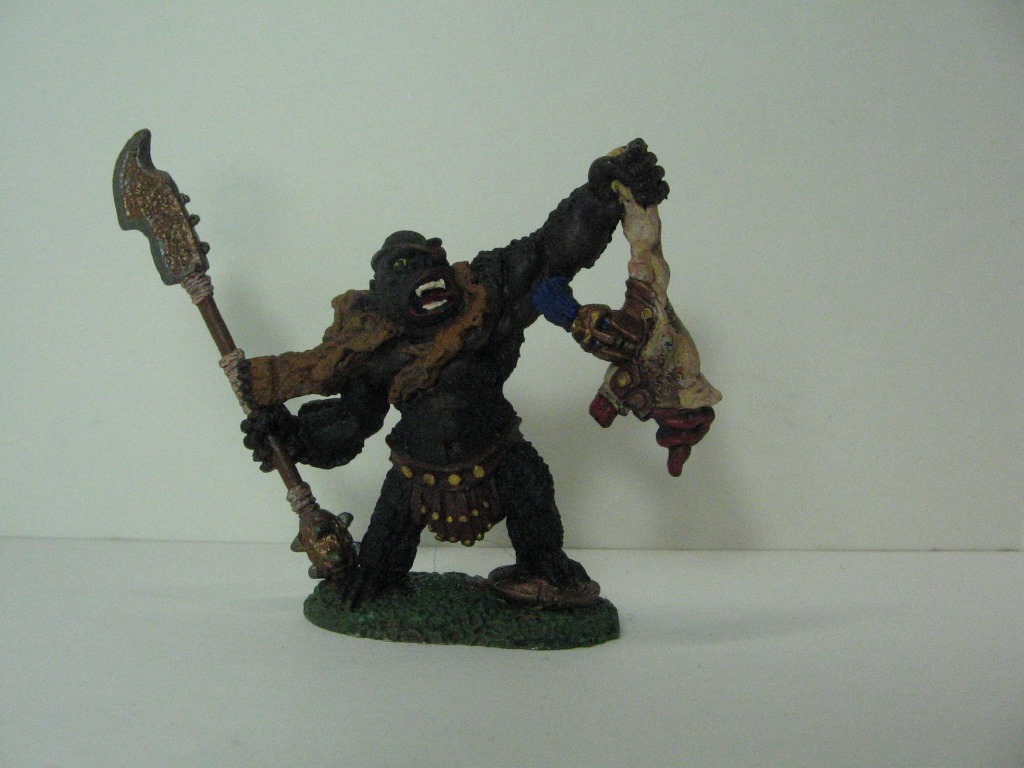
Now I just need to get better at photographing:


Monday, September 14, 2020

Miniatures

Reapercon has come and gone and it got me thinking about miniatures (plus the non-stop painting for the past year and a half since my Bones Kickstarter arrived)

I enjoy mini's for their own sake.  Before D&D I was into model trains and towns (not that I could afford any besides what went under the tree).  Legos too.  So even if not for RPGs I would likely have spent a good chunk of my free time painting tiny people and buildings.

My first D&D games used a mix of the DMs HeroQuest, Ral Partha, and Grenadier minis.  When I brought my Dark World minis, the collection nearly doubled.  Minis seemed a natural thing, after all, it is a game and games have pieces.  It was a year or two later playing with a different group that I was introduced to "theater of the mind".

So in short, I like minis.  I like painting them as a hobby, and I use them frequently in RPGs (current state of the world and no in-person D&D not withstanding).

I do wish that early D&D had settled on a 1' = 1yard (or meter) scale.  It would have given us army men sized minis which I think would have opened up a bigger world to mini sculpts earlier on.  It also would have made map scales make more sense where the markers for doors/windows are concerned, but that is a different discussion.

So that said, I don't mind the overall trend to larger minis.  Though, it is weird having some Halfling/Dwarf minis that are burlier than my classic barbarians.  I appreciate having more room to work with paint.  Somewhat in-congruently, I am less of a fan of they overly detailed minis that are coming out in recent years.  They gave me bigger minis that are easier to paint, but then crammed them full of tiny details!!!  Also, I feel the details and bits, makes it less and less likely that the minis is a "fit" for your character.  But I guess if you want that level of compatibility, you go to Heroforge

Bones are great, and I have great luck repainting old D&D Miniatures in addition to those ancient board game dudes.  But I still think metal is better.  Maybe because it is what I learned with, I find painting to be easier.  I enjoy the literal flexibility.  So whenever I can, I try to pick up things from my wishlist on the Reaper metal catalogue,  especially if it is something unlikely to be made into Bones.  (I may prefer metal, but my wallet prefers plastic)

That said, I wish Reaper has a Sort by Sculptor function.

And lest I give all the love to one company, I highly recommend https://www.darkswordminiatures.com/  they have some great quality sculpts that have a very different aesthetic than traditional D&D style minis.

Sunday, September 6, 2020

More Mutants More Masterminds

How I went about putting together a game for Mutants & Masterminds (which I have still yet to run)

We previously etablished that after years of playing around with the system, I had settled on a 2.5 Edition as a mix of 2e  d20 core and 3e versatility in powers and effects.  Part of the reason I settle on this was that I assumed most players would be coming from a D&D background.

Many of the following points will be familiar to my discussion of Star Wars.  Since it is an unfamiliar system, and not one designed around advancement, I opt for a "quick shot" of sessions. I assume players will want to play brand name heroes (or something very close). 

While DC is personally my jam, the Avengers/MCU and Netflix shows were the owners of the zeitgeist. The Avengers, being top tier heroes and the movies being interlocked feels too restrictive for how I want to run a licensed game.  So I settle for the nice street level Netflix "Defenders".  The bonus at the time was the shows were in purgatory with impending cancellation, freeing my up continuity-wise.

So first things was stating out the characters using my two-tier characters sheet (one tab to build/one tab to reference during play).  I wanted to make sure the characters were balanced against one another.  Jessica Jones and "Iron Fist" can damage Luke Cage.  Iron Fist is better 1v1 and Daredevil can sweep a room.  I also throw in Punisher, which was an interesting challenge, since his powers are Guns and Rage.  Its not too long before I have them dialed in at PL 8 and a good idea of what they can take on.  I also throw in Blade, because I want too.

So, what will be the threat?  I went back and forth on ideas, what is something that will be more interesting than a bunch of ninja's or special forces, but not TOO big for this group.  Thankfully the movies ended up delivering.  "The SNAP" gives the perfect opportunity, major heroes are gone, the worlds is in disarray, and our heroes need to step up.  And because of studio politics, there will never be any worries of continuity (so I should not have to worry about rewriting this if we don't play for awhile - which is proving to be the case)

 Generating content is easy, maps of NYC, quick stats for police, ninja, special forces, generic goons.  But I need a villain for them to face off in a climactic battle and the mastermind behind it all.  I think Tombstone is unaccounted for and would make a good fit.  Also he is obscure enough I can tweak his power level to be threatening to the whole party. Taking cues from other media, it looks like he is distributing drugs laced with terrigen to create inhumans in order to force a conflict between the populace and enforcement agencies.  Part of the details are purposely vague at this point to leave me room to adapt and "yes and..." the player's ideas.

The inhuman angle also allows me to throw more "supers" at the party, so I make some low level knock off X-men as baddies as well.  This will allow me to get some practice with battles before the game progresses too far.

One day we will see how it went....